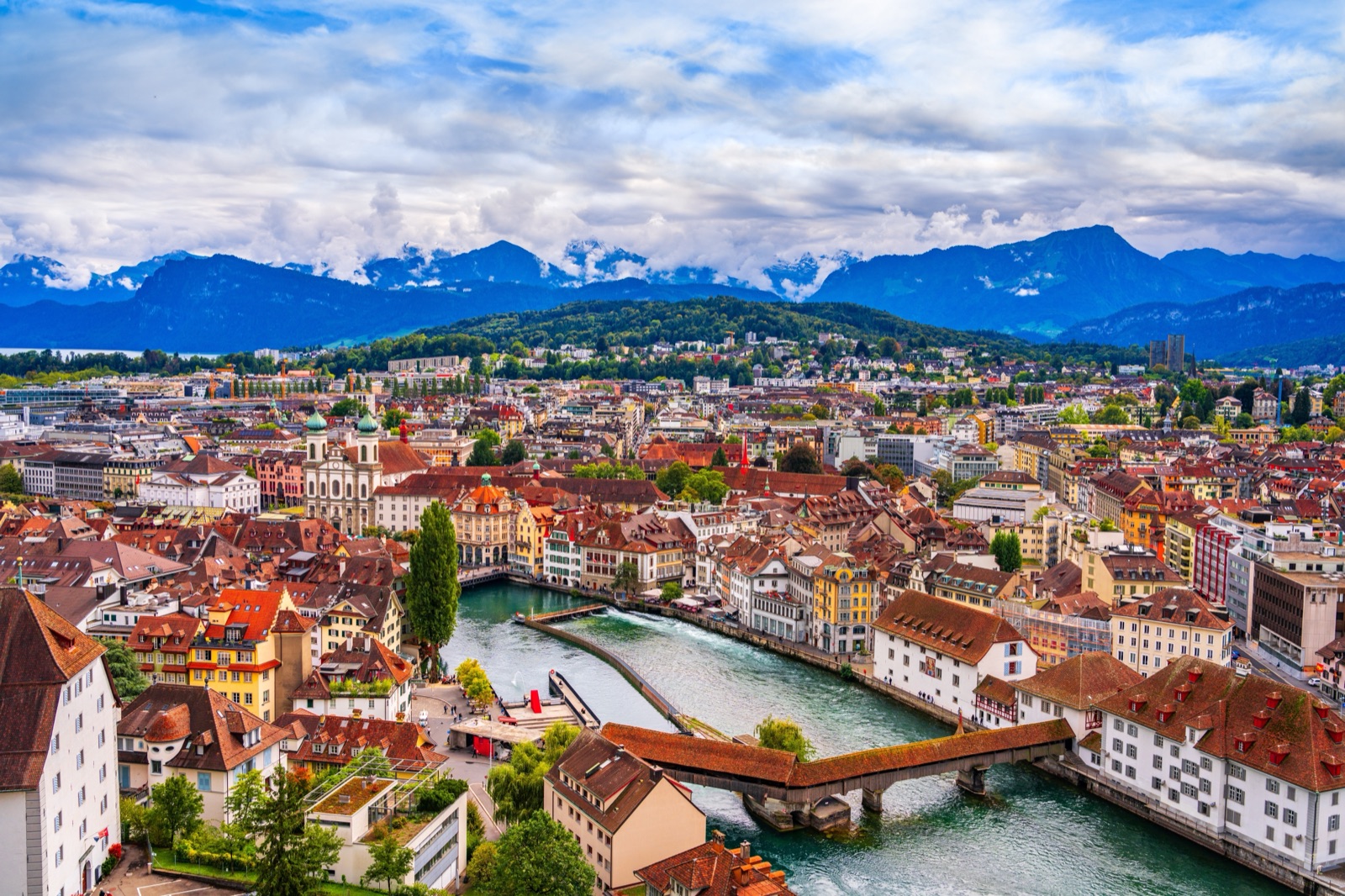
Getting to Lake Lucerne: Trains from Zurich, the Airport, Basel and Bern
The easiest way to Lake Lucerne is by train to Lucerne station, which stands right on the lake: the boat piers are in front of it. From Zurich main station, direct IR and IC trains run every 30 minutes and take 45 to 50 minutes. Zurich Airport is about one hour away by train or car, and direct trains run hourly from Bern (1 hour) and Basel (1 hour 15 minutes). From the south, trains from Lugano come through the Gotthard Base Tunnel in 1 hour 40 minutes to 1 hour 50 minutes.
This guide covers each starting point, how to get from the train to the boats, how to reach the villages around the lake, and the tickets and passes that make the journey cheaper.
The journey at a glance
| From | How | Time to Lucerne |
|---|---|---|
| Zurich main station | Direct IR and IC trains every 30 minutes | 45 to 50 minutes |
| Zurich Airport | Direct train, or car | About one hour |
| Bern | Direct IR train every hour | 1 hour |
| Basel SBB | Direct IR train every hour | 1 hour 15 minutes |
| Interlaken Ost | Lucerne–Interlaken Express every hour | 1 hour 50 minutes |
| Lugano | IR or EC via the Gotthard Base Tunnel | 1 hour 40 minutes to 1 hour 50 minutes |
| Lausanne | Direct IR train every hour | 2 hours 20 minutes |
| Grindelwald | Via Interlaken Ost | 2 hours 35 minutes to 2 hours 45 minutes |
| Zermatt | Via Bern and Visp | 3 hours 15 minutes |
Lucerne’s tourist board sums it up simply: the cities of Zurich, Basel and Bern can each be reached in about one hour from Lucerne, and Switzerland’s dense rail network does the rest.
Where Lake Lucerne actually begins
Lake Lucerne is large, 114 km², and has several arms, so “getting to the lake” can mean different places. For almost every visitor, though, the answer is the city of Lucerne, at the lake’s north-western end. The station, the main boat piers, the KKL concert hall (2 minutes’ walk from the station) and the old town are all within a few minutes of each other.
From Lucerne, boats, trains and buses fan out to the other lakeside towns: Weggis and Vitznau at the foot of Rigi, Alpnachstad for Pilatus, Kehrsiten for the Bürgenstock, and Brunnen and Flüelen at the far end. If you are staying in one of those villages, you will usually travel to Lucerne first and continue from there.
From Zurich
Zurich to Lucerne is the most common route, and the simplest. Direct IR and IC trains run from Zurich main station to Lucerne every 30 minutes, taking 45 to 50 minutes. There is no need to book a seat on these trains; buy a ticket, or use a pass, and board.
As a day trip from Zurich, the lake works well: an early train gets you to Lucerne in time for a morning boat, and the frequent trains back mean you can stay for dinner. A typical day from Zurich:
- Morning: train to Lucerne, then a short cruise or the catamaran to the Bürgenstock.
- Midday: lunch by the lake or in the old town.
- Afternoon: the Chapel Bridge and the old town, or a boat to Weggis or Vitznau.
- Evening: train back to Zurich.
For a longer day, combine the boat with Rigi or Pilatus; the Pilatus or Rigi guide has the round trips.
From Zurich Airport
Zurich Airport is the main gateway for international visitors. Lucerne’s tourist board gives it as about one hour away by train or car, with a direct train connection that saves changing in the city. Zurich Airport has direct flights to 185 destinations in 66 countries, so it is the natural airport for most trips to the lake.
If your flight arrives late in the day, it is worth knowing that trains run frequently into the evening, and that the reservation confirmation for a Lucerne city hotel counts as a public transport ticket within the city zone on your first journey to it (see below).
From Basel and EuroAirport
From Basel SBB, direct IR trains run to Lucerne every hour, taking 1 hour 15 minutes. Lucerne is also easily reached by train or car from EuroAirport Basel-Mulhouse, which can be a useful alternative to Zurich for flights from some European cities.
From Bern, Geneva and Lausanne
From Bern, direct IR trains run every hour, taking 1 hour. From Lausanne, there is a direct IR train every hour, taking 2 hours 20 minutes. Geneva Airport and Bern-Belp are also listed as airports from which Lucerne is easily reached by train or car, although from Geneva the journey is considerably longer than from Zurich.
From Interlaken and the Bernese Oberland
The Lucerne–Interlaken Express links Interlaken Ost and Lucerne over the Brünig Pass, with connections every hour and a journey of 1 hour 50 minutes. It is one of the most scenic ways to arrive, passing lakes and mountain villages on the way. From Grindelwald, the journey via Interlaken Ost takes 2 hours 35 minutes to 2 hours 45 minutes.
From Zermatt, allow 3 hours 15 minutes, via Bern and Visp.
From Ticino and Italy
From Lugano, IR or EC trains run via Arth-Goldau and the Gotthard Base Tunnel directly to Lucerne, taking 1 hour 40 minutes to 1 hour 50 minutes. Travellers coming from Lake Como or Milan usually join this line.
There is also a slower, more scenic way to arrive from the south: the Gotthard Panorama Express, which combines a train over the historic Gotthard line with a boat trip of nearly three hours along the lake. Done in the north-to-south direction, it is also a memorable way to leave. The one-day planning guide describes it in detail.
By car
Lucerne has motorway connections to Zurich, Bern and Basel, as well as to the whole of Central Switzerland and the Bernese Oberland. Driving makes sense if you are touring, but a car is of limited use on the lake itself: the best of it is seen from the boats, and city-centre parking takes planning.
If you drive, consider leaving the car at your hotel and using the boats and trains for day trips. The lakeside villages are linked by boat, and the mountain railways start at the piers.
By coach
Long-distance coaches stop at the coach park at Landenberg/Alpenquai, about 10 minutes’ walk from the city centre. Check the exact stop with your coach company, as it is not at the railway station.
From the station to the boats
This is where Lucerne is at its most convenient. The lake piers are directly in front of the station, and each has its own routes:
| Pier | Boats to |
|---|---|
| Pier 1 | Weggis, Vitznau (for Rigi), Brunnen, Flüelen |
| Pier 2 | Alpnachstad (for Pilatus) |
| Pier 3 | Küssnacht am Rigi, Bürgenstock |
From the station exit, you can be on a boat in a few minutes. Tickets can be bought on all boats and at the ticket offices in Lucerne and Weggis, and from spring to autumn also in Brunnen and Vitznau. Seats are not reserved on scheduled boats, except for a table in the onboard restaurant, and groups of 10 or more are asked to register in advance.
The boats and tickets guide explains the routes and sailing times in detail.
Reaching the lake villages
Once in Lucerne, the other lake towns are easy to reach:
- Weggis: about 45 minutes by boat from pier 1.
- Vitznau: about 55 minutes by boat, for the Rigi railway.
- Beckenried: about 1 hour 15 minutes by boat; scheduled boats between Lucerne and Flüelen stop there.
- Brunnen: about 2 hours 10 minutes by boat, the start of Lake Uri.
- Flüelen: about 2 hours 45 minutes by boat, at the far end of the lake.
- Bürgenstock: 25 minutes by catamaran from pier 3, then the funicular; see the Bürgenstock guide.
- Alpnachstad: by boat from pier 2 in summer, or by train, for the Pilatus cogwheel railway.
- Engelberg (for Titlis): the Luzern–Engelberg Express takes 43 minutes.
Several of these places also have train or bus connections, which are quicker but less scenic than the boat.
Tickets and passes
Most visitors use one of these:
- Swiss Travel Pass and Swiss Travel Pass Flex. Valid on trains, buses and the scheduled lake boats, and on many mountain railways. Good value if you are travelling around Switzerland.
- Lucerne Travel Pass (formerly Tell-Pass). Free travel on trains, buses, boats and many mountain railways in Central Switzerland for 3 to 10 consecutive days. The best choice if you are based on the lake.
- Half-fare card. Gives 50% off train and boat fares; worth it for longer stays.
- Ordinary tickets. For a single day trip from Zurich, a return ticket plus a boat ticket can be enough.
Two details catch people out. First, Passepartout regional tickets are not valid on the lake boats, except monthly and annual travelcards covering zones 10, 29 and 39 between Lucerne, Hertenstein, Weggis and Vitznau. Second, combined tickets for boat and mountain are sold not only by the boat company but also by SBB, the Rigi and Pilatus railways, the Treib-Seelisberg railway and the tourist offices in Beckenried and Gersau, so compare before you buy.
For families, children up to 16 travel free on the boats with a Junior Card when accompanied by a parent; children aged 6 to 16 otherwise get 50% off.
The Visitor Card and your first ride
If you stay overnight in the city of Lucerne, you receive the Visitor Card, which gives free 2nd-class buses and trains in zone 10 of the city network (the boat is not included). Even before you have it, the reservation confirmation for your accommodation is accepted as a public transport ticket on your first journey to it. So from Lucerne station, you can take the bus to your hotel without buying a ticket.
The where to stay guide covers the visitor cards in the lakeside villages too.
Getting around Lucerne once you arrive
The city centre is compact, and most visitors walk: the station, the piers, the Chapel Bridge and the old town are all close together. For anything further, there are several options:
- City buses. The local bus network covers the city and suburbs; with the Visitor Card, buses in zone 10 are free. The lido and the Swiss Museum of Transport, for example, are reached by bus 6, 8 or 24 from the station to the Verkehrshaus - Würzenbach stop.
- Trains. Suburban S-Bahn trains also leave from the main station; the S3, for example, stops at Verkehrshaus.
- Bicycles. Day-hire bikes are available, and the tourist information office at the station sells hire codes at a reduced price.
- Boats. Not only for sightseeing: the scheduled boats are a genuine way of getting between the lake villages.
Arriving with luggage, a pushchair or a wheelchair
If you arrive on a day trip with bags, Lucerne’s tourist board points to a network of luggage storage points around the city, so you do not need to carry your suitcase on the boat. Many hotels will also hold bags before check-in.
For travellers with reduced mobility, the tourist board publishes a list of accessible sights, restaurants and cultural attractions in the Lucerne and Lake Lucerne region. Lucerne station and the main piers are close together, which keeps transfers short. Among the regional trains, the Luzern–Engelberg Express has low-floor entrances and wheelchair spaces, which makes the Titlis trip easier. On the lake itself, the boats are worth checking route by route, particularly the historic paddle steamers.
Lucerne as a hub for day trips
Because the rail connections are so good, many visitors use Lucerne as a base and make day trips out, rather than moving hotel. From the station:
| Destination | Route | Time each way |
|---|---|---|
| Zurich | Direct IR or IC, every 30 minutes | 45 to 50 minutes |
| Bern | Direct IR, every hour | 1 hour |
| Basel | Direct IR, every hour | 1 hour 15 minutes |
| Interlaken | Lucerne–Interlaken Express, every hour | 1 hour 50 minutes |
| Rhine Falls | IR to Zurich, then S-Bahn | 1 hour 50 minutes |
| Lugano | IR or EC via the Gotthard Base Tunnel | 1 hour 40 minutes to 1 hour 50 minutes |
| Lausanne | Direct IR, every hour | 2 hours 20 minutes |
That said, Lake Lucerne itself has more than enough for several days: the boats, the old town, Pilatus, Rigi, the Bürgenstock, Titlis and Lake Uri. Most visitors with three or four days find they never need to leave the lake.
Arriving in winter
Trains run all year, and so do the boats, on a reduced winter timetable from 19 October 2026 to 16 April 2027. The Bürgenstock catamaran runs all year. Some connections change in winter: the boat between Lucerne and Alpnachstad stops for the season, and the Pilatus cogwheel railway closes. Check the season before planning a lake-and-mountain day, and see the best time to visit guide for what is open month by month.
Mistakes to avoid
- Buying a regional ticket for the boat. Passepartout tickets are generally not valid on the lake boats.
- Going to the wrong pier. Check whether your boat leaves from pier 1, 2 or 3.
- Driving into the centre for a day trip. The train is faster from Zurich, Bern and Basel, and the boats start at the station.
- Ignoring the Visitor Card. City-hotel guests ride buses and trains in zone 10 free; there is no need to buy local tickets.
- Planning Pilatus by boat in winter. The Alpnachstad boat and the cogwheel railway are seasonal.
Frequently asked questions
How long is the train from Zurich to Lake Lucerne? Direct trains from Zurich main station to Lucerne take 45 to 50 minutes and run every 30 minutes.
How do I get from Zurich Airport to Lake Lucerne? By train or car, in about one hour. There is a direct train to Lucerne, where the boats leave from piers in front of the station.
What is the nearest airport to Lake Lucerne? Zurich Airport is the closest major airport and the usual choice. EuroAirport Basel-Mulhouse, Bern-Belp and Geneva are alternatives.
Is Lake Lucerne a good day trip from Zurich? Yes. With trains every 30 minutes, you can spend a full day on the lake and return in the evening. A cruise from our tours page is an easy way to fill the day.
Do I need to book the train? Not on the regular IR and IC trains between Zurich and Lucerne; buy a ticket or use a pass and board.